Profit
What each product keeps after discounts, refunds, fees and its cost, not just what it sold.
Hoodie 2 / B sold US$5,824.99 and still lost money.
The recovery ledger
Most tools stop at a dashboard. Mintwise keeps a ledger: each money leak it finds, the orders that prove it, what you did about it, and what that brought back.
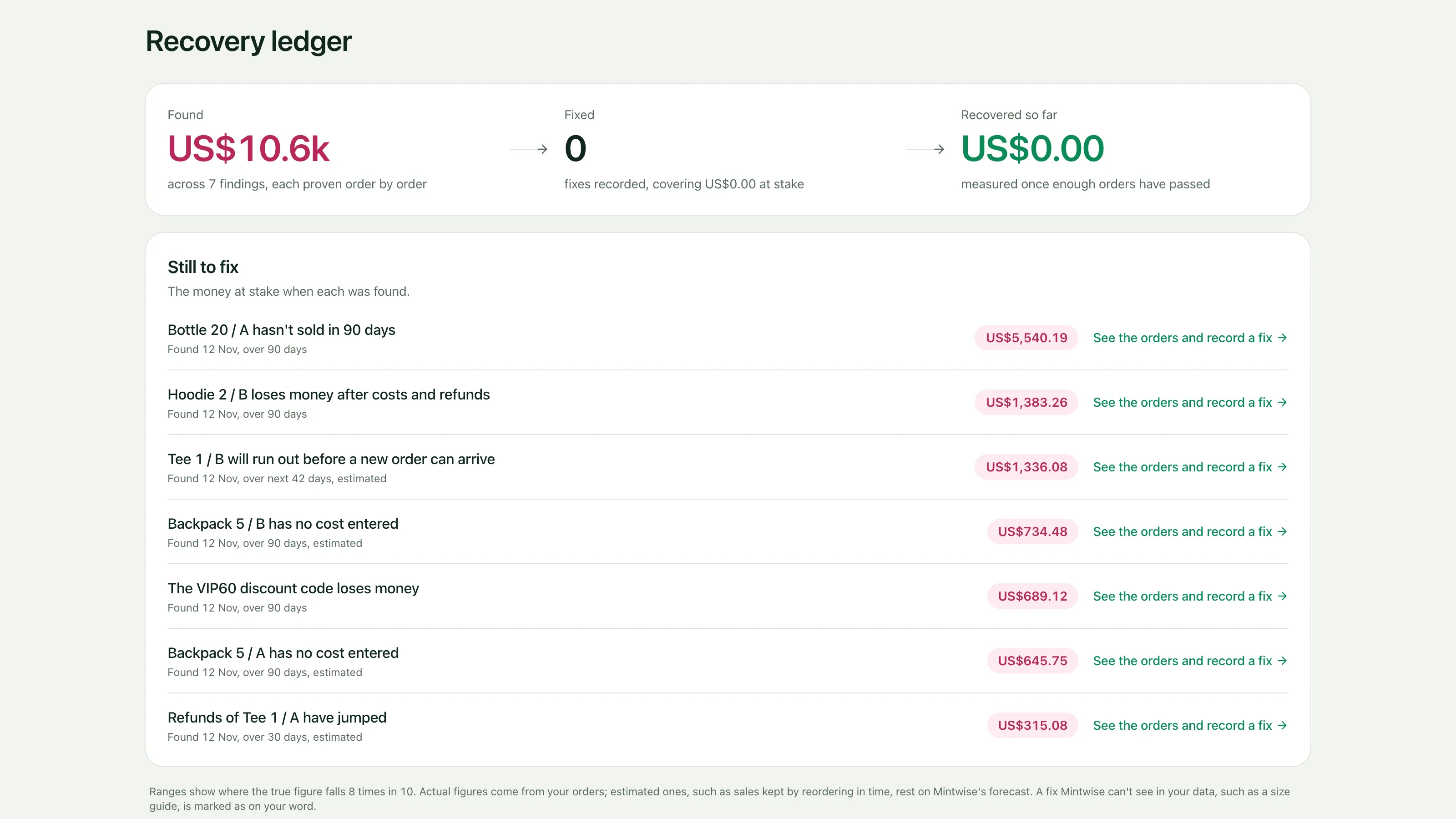
Mintwise's recovery ledger.
The first four tell you what's wrong. The last two are what make it a ledger: your fix goes on the record, and so does what it did.
Each night Mintwise checks the last 90 days of your store for money leaks and stock risks, from a product sold at a loss to a discount code that leaves nothing after costs.
Every finding lists the order lines that add up to it: what each sold for, the discount, the product's cost, the refund, and what was kept. No customer details, and each order opens in Shopify.
Each finding carries the money at stake and says how it was worked out: actual, from your orders, or estimated, with what the estimate rests on.
In plain words: check the cost, raise the price, end the code, reorder by Friday. Mintwise never makes the change itself.
Tell Mintwise what you fixed and when. It looks for the change in your store's data each night, such as a new price or a code that ended. What the data can't show is marked as on your word.
It compares before and after, against the rest of your store over the same weeks, and gives the amount with its likely range. Until enough orders have passed, it says it's too early to tell.
What it covers
Every plan has the ledger, true profit, leaks, returns and stock warnings. Growth and Scale add the areas that need more of your data.
What each product keeps after discounts, refunds, fees and its cost, not just what it sold.
Hoodie 2 / B sold US$5,824.99 and still lost money.
Which products come back, the reason customers picked, and what they actually wrote.
Mintwise keeps each note's cause, never the customer's words.
Every plan has returns by product and by the reason picked in Shopify.
What runs out and when, what to reorder by which day, and what isn't selling.
62 left
Runs out 26 Nov
Order 200 today: the supplier takes 14 days
Every plan warns when stock is about to run out, and when it isn't selling.
Profit after ads by platform, campaign, ad and product, from the spend you upload.
From orders tagged with each campaign, not the platform's own count.
Who comes back, who is drifting away, and the Shopify segment that reaches them.
518
Counts and money only. Mintwise never keeps a name or an email address.
Fast sellers priced too low, price tests you run, and what past price changes did.
Keep the new price
It kept US$412.60 more than US$67.95 would have, likely US$188.30 to US$636.90.
Each supplier's margin, returns, ratings and complaints, set against your whole store.
Worse on two measures: one to watch.
Days to ship and in transit by carrier, and parcels that arrived later than promised.
131 of USPS's 230 delivered parcels arrived after Shopify's estimate.
Listings missing a description, photos or search text, your best sellers first.
Every night
New orders and refunds come in from Shopify as they happen. The sums are done once a day, at 3 am your store's time, so the figures you read in the morning don't move under you.
What it reads
Orders1,513 order lines in 30 days
Refunds and returns371 refunds, with the reason picked
Products and costs40 variants, each with its cost
Stock40 stock levels
ParcelsDates, status and carrier
Ad spend and reviewsIf you upload them
Every night at 3 am, your store's time
Ready by morning
Recovery ledger7 new findings, each in dollars
Daily briefIn the app and by email
Ask MintwiseAnswers from the same figures
Counts over 30 days, 10 October to 8 November 2026.
Ask Mintwise
Ask Mintwise answers from your own store's figures. Every number in an answer comes from a calculation it can show you, never from the AI's memory, and an answer that can't be backed by your data isn't given.
Which products lost money in the last 30 days?
Only one product lost money in the last 30 days (10 Oct to 8 Nov): Hoodie 2 / B. It sold USD 5,824.99 across 94 units, including USD 234.13 in refunds, and you lost USD 1,762.88 on it after product costs, refunds and fees. The next-lowest product, Hoodie 18 / B, still kept USD 188.43. Mintwise also has a finding that Hoodie 2 / B loses money. You raised its price on 1 Oct, but the figures show no clear change yet.
The figures it used
What should I reorder this week?
Order Tee 1 / B today (2026-11-15). Mintwise says to order 200 units, costing USD 2,186. It has 62 units left and is forecast to run out on 2026-11-26. That date is 2026-11-24 if sales run high. The supplier lead time is 14 days. It's the only product to order today. Tee 17 / A is next: order 18 units by 2026-11-22, costing USD 930.60. Hoodie 18 / B and Jacket 16 / A have order-by dates of 2026-11-30 and 2026-11-29, so they fall after this week.
The figures it used
Which carrier is slowest to deliver? Use the last 30 days.
USPS is the slowest carrier over the last 30 days (2026-10-10 to 2026-11-08). Its parcels took a median of 4.7 days from shipping to delivery. UPS took 3.4 days, Acme Couriers 3.5 and parcels with no carrier set 3.2. USPS also took a median of 2.2 days from order to shipping. 56.96% of its delivered parcels (131 of 230) arrived after Shopify's estimate. For UPS that share was 19.85%. Acme Couriers' delivered dates are set by hand in Shopify, so its times may not be exact.
The figures it used
An answer Ask Mintwise gave, word for word.
Mintwise installs as an app and opens inside your Shopify admin. It brings in your history and works out every day up to yesterday straight away.
It reads each product's cost per item from Shopify. If some are missing, it lists them and takes a spreadsheet.
Upload exports from Meta Ads, Google Ads or your review app to add profit after ads and what reviewers complain about. There are no extra accounts to connect.
Send a few Shopify exports, with your customers' details taken out. About a week later you get 3 to 5 findings, each with a dollar figure and what you could do about it. It costs nothing, and nothing in your store changes.
$16,190 in sales, but a loss once costs, discounts and refunds are counted.
$12,404 taken off orders that made a loss after product costs.
Your profit looks higher than it is, by this much in 30 days.